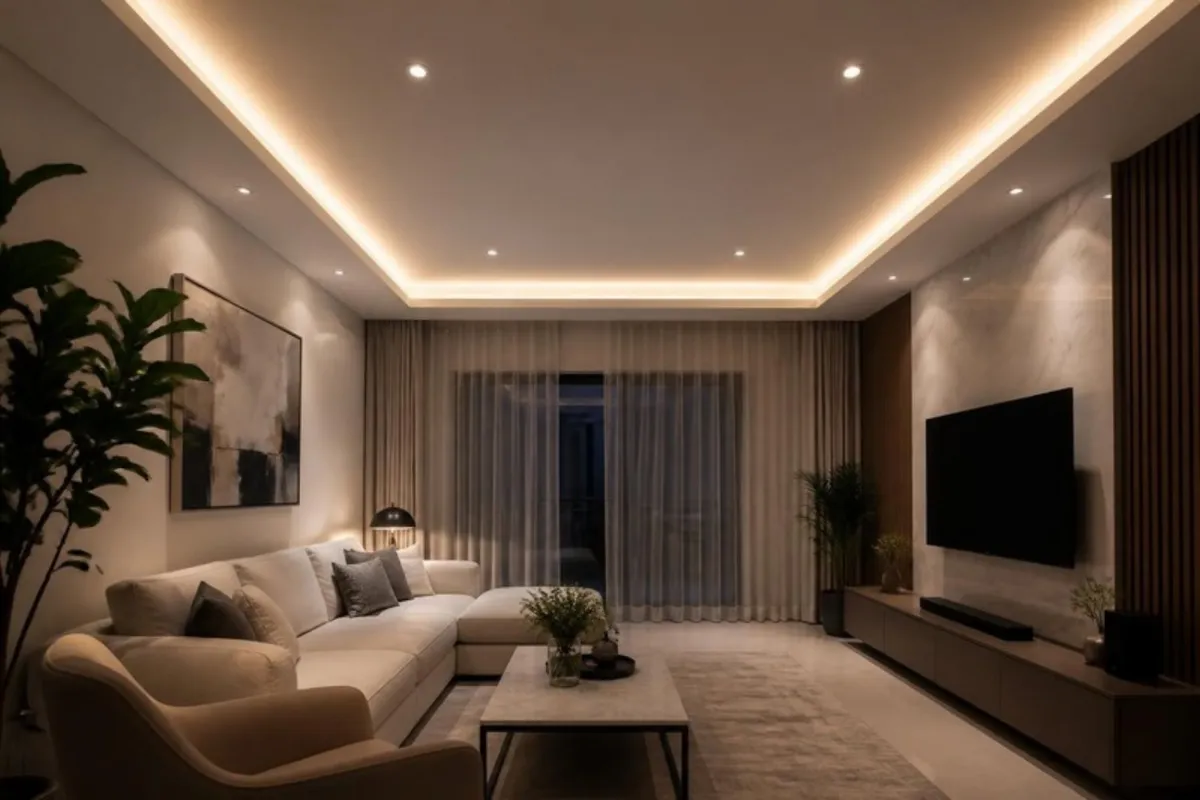
Quick answer: The best living room lighting uses layers: soft ambient light from downlights or cove lighting, a statement pendant or chandelier as a focal point, and accent lights for walls and shelves. Use warm white throughout and control each layer separately.
A living room has to do many jobs: relaxing, entertaining, reading and sometimes working. One ceiling light in the centre of the room cannot do all of that well. The answer is to think in layers.
Start with ambient light
Ambient light is the base layer that lets you move around comfortably. Recessed downlights or concealed cove lighting give a clean, even result without visual clutter. Put them on a dimmer if you can, so the room can shift from bright to cosy.
Add a statement piece
A pendant or chandelier above the seating area or coffee table gives the room a focal point. Ring pendants and slim linear designs suit contemporary interiors, while a crystal chandelier adds a more classic character. Scale matters: a fitting that is too small will look lost.
Use accent lighting for depth
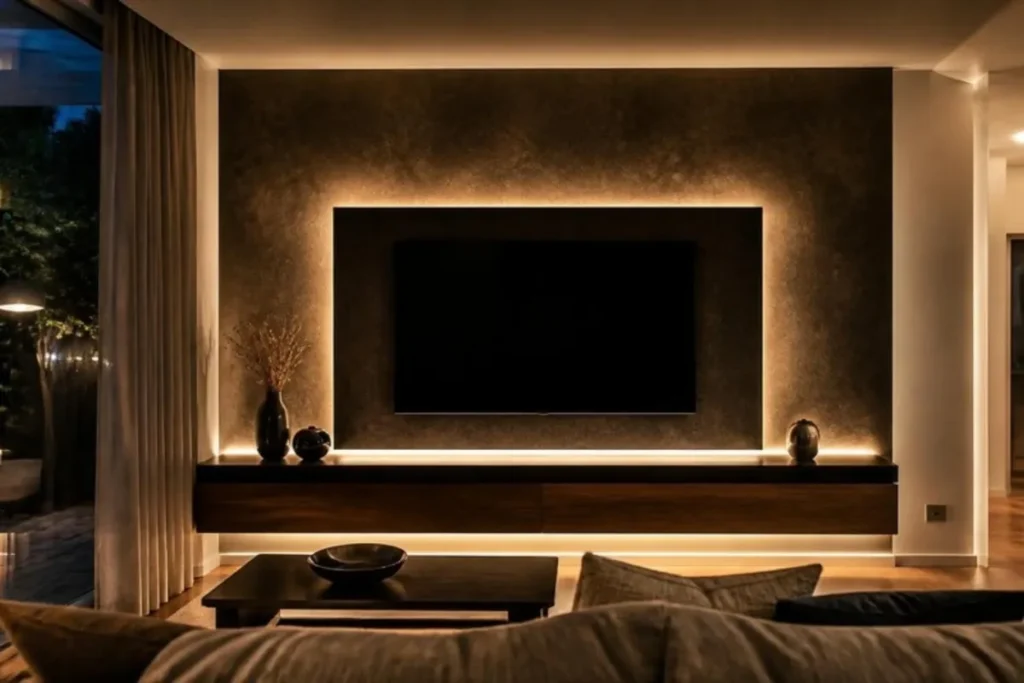
Wall lights, picture lights and LED strips behind a TV unit or shelves add depth and make the room feel larger in the evening. They also reduce glare when you are watching television.
Do not forget the switches
Group your lights into separate circuits so each layer can be controlled on its own. Good quality switches and sockets are a small part of the budget but something you touch every day.
Looking for fittings for your living room? Browse the shop, or send us a photo of a design you like and we will source it.
Light the TV wall properly
A bright screen against a dark wall strains the eyes. A warm LED strip behind the TV or a soft wall wash reduces the contrast and makes the wall a feature. Keep downlights from shining directly on the screen, where they cause reflections.
Small living rooms
- Light the walls and ceiling rather than the floor to make the room feel bigger.
- Choose flush or slim fittings instead of a large hanging light where the ceiling is low.
- Use wall lights to free up floor space.
Open-plan living and dining
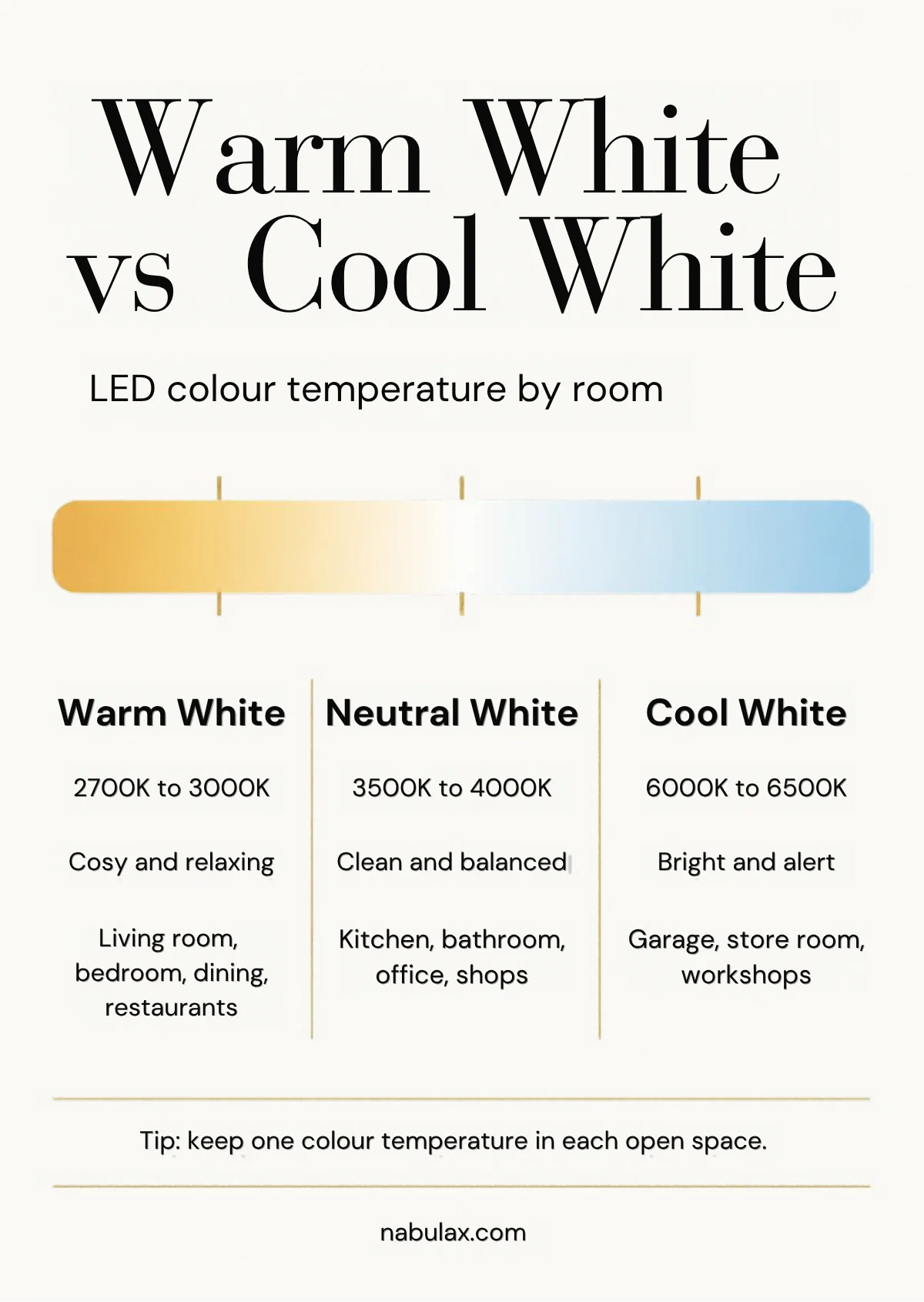
Use lighting to define each zone. A pendant over the dining table, a different feature over the seating area and a line of downlights for circulation tell the eye where one space ends and the next begins. Keep the colour temperature the same across all zones.
What to buy: a simple checklist
- Dimmable recessed downlights for general light
- LED strip for cove or TV wall, with a quality driver
- One statement pendant or chandelier, sized to the room
- Two or more wall lights or a floor lamp
- Quality switches, with a dimmer on the main circuit
Frequently asked questions
How many lights does a living room need?
A medium living room of about 12 ft by 14 ft typically uses around six downlights plus a decorative light and one or two accent lights.
What colour light is best for a living room?
Warm white, around 2700K to 3000K, for a relaxed and welcoming feel.
Should living room lights be dimmable?
Yes. Dimming lets one room work for entertaining, watching television and relaxing.
